Renovating a house in Ostuni: costs, permits and materials
Ostuni is not an ordinary town. The whitewashed historic centre, the masserie of the Valle d'Itria and the coastal strip down to Villanova each call for different work, with materials and precautions you would not need elsewhere. Here are the real costs, the permits that genuinely apply and the right way to work the local stone.
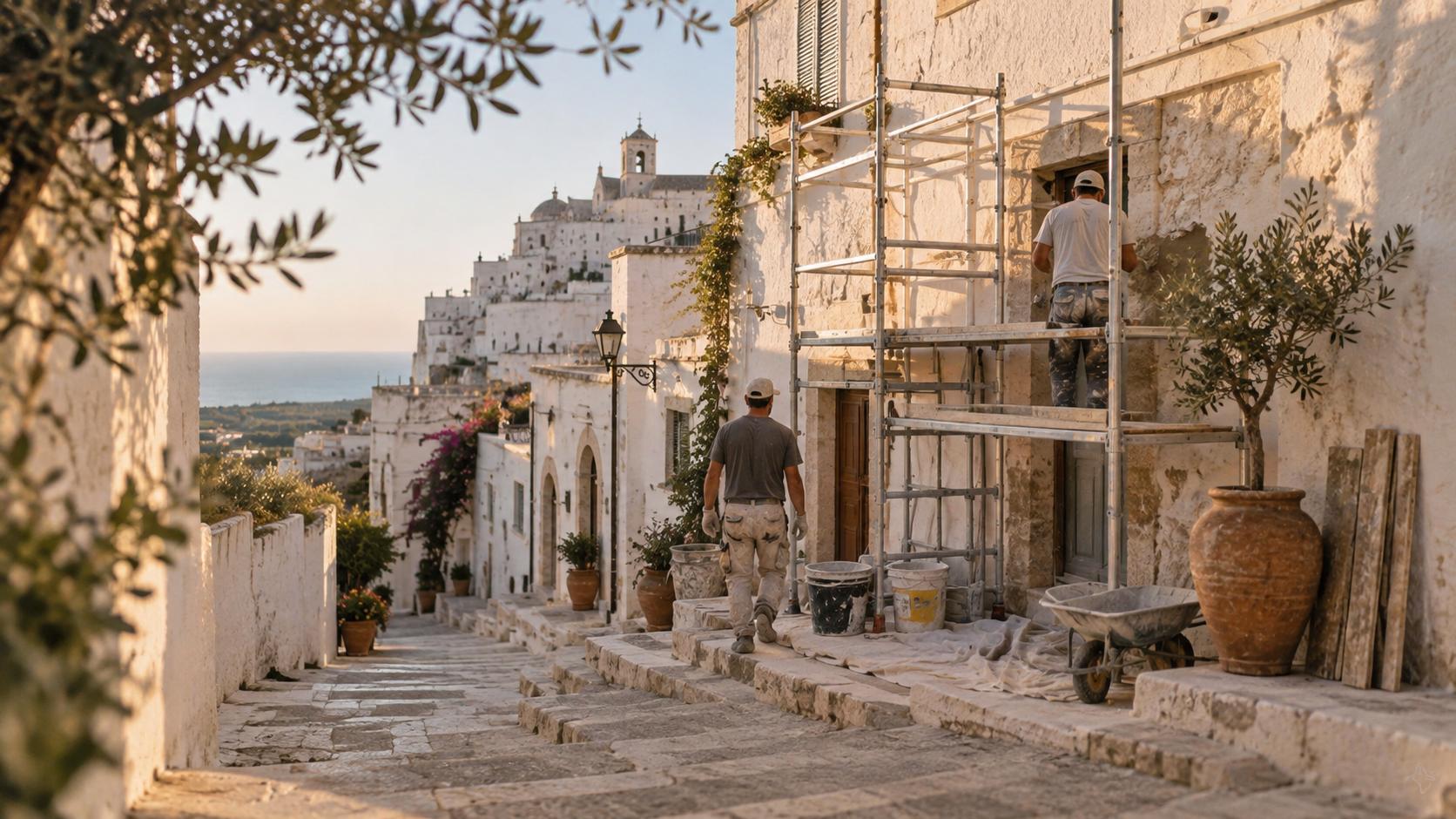
Ostuni and the Valle d'Itria: where renovation really happens
The territory of Ostuni moves along four very different tracks. The first is the White Town itself: the historic centre crowning the hill around the Gothic cathedral with its rose window, a tangle of lanes, steps and courtyard houses with thick stone walls, vaulted ceilings and chiancarelle stone roofs. People renovate here for the love of the stone, but the narrow lanes keep heavy vehicles out and every material has to be carried in by hand or with small machines. The second track is the newer districts at the foot of the hill, towards the station and along the roads to Fasano and Carovigno: flats and small houses from the last thirty years, ripe for a straightforward modern refit. The third is the countryside of the Valle d'Itria, with trulli, lamie and masserie among the olive groves, bordering Ceglie Messapica, Martina Franca and Locorotondo: stone structures to consolidate, conical roofs to repair, courtyards and dry stone walls to bring back to life. The fourth is the coast, from Villanova di Ostuni down to Quarto delle Rose and Rosa Marina, with holiday homes, terraced houses and flats exposed to sea salt. Each track has its own budget, paperwork and problems: treating them all the same way is the surest way to get both the timeline and the quote wrong.
What it costs to renovate in Ostuni
Local prices stay in line with the regional range: a full renovation comes in between 190 and 430 euros per square metre of floor, and almost all of the spread depends on the starting condition and the finish you choose. A 90 square metre flat at the foot of the historic centre therefore means 17,000 to 39,000 euros of building work, plus design, paperwork, furniture and appliances. The typical breakdown never changes much: services (electrical, plumbing, heating) run 25 to 30 per cent of the total, finishes 35 to 45, demolition and structure 10 to 20, with the rest going on paint, windows and contingencies. A 4 to 6 square metre bathroom takes 3,000 to 7,000 euros; a kitchen costs 300 to 600 euros per square metre for the building work alone. In the historic centre you have to budget from day one for rubble carried out by hand where mini diggers cannot reach, narrow scaffolding on sloping ground, and the surprises hidden in old walls: on these properties a 10 to 15 per cent margin on the budget is the rational choice, not pessimism. Trulli and masserie add another layer: consolidating stone structures, specialist roof work and services threaded through solid masonry. If a quote sits well below the range, something is missing: ask for an itemised bill of quantities and read it line by line.
Tufa, limestone and chianche: the local materials
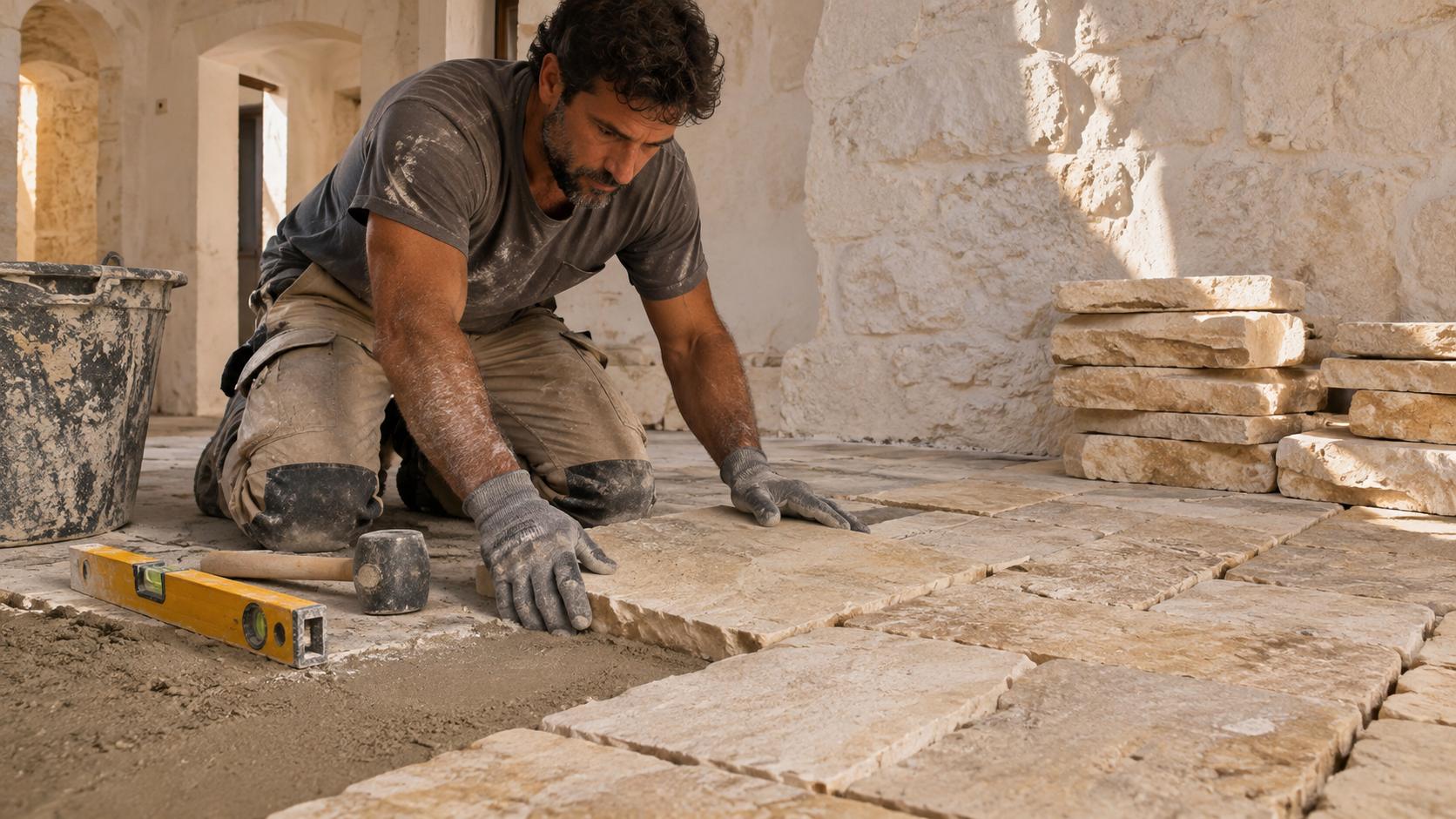
Ostuni is built in local limestone, traditionally rendered and whitewashed with lime. The lime is what makes the White Town white, and it is not just decoration: it protects the walls and lets them breathe. Traditional floors are chianche, irregular slabs of pale limestone honed by hand, and they need an expert layer: the slabs must be sorted, dry laid and bedded on the right screed, otherwise they rock and crack within a year. Historic roofs use chiancarelle, thin overlapping stone slabs, or clay tiles on more recent buildings; vaults, barrel or cross, must be consolidated before they are finished, never simply skimmed over. The rule that applies everywhere in this territory is never to cover old masonry with materials that cannot breathe: cement mortars on stone and lime walls are the single biggest cause of blistering, detachment and mould, because they trap moisture inside the wall. Where repairs are needed, the answer is lime mortars with porous aggregates, dehumidifying plasters and breathable paints. On chiancarelle roofs you want a local master mason who actually knows the stone: contractors who only work with modern systems tend to bury everything under waterproof membranes and insulation, and the result lasts one season.
Wall damp and the sea wind
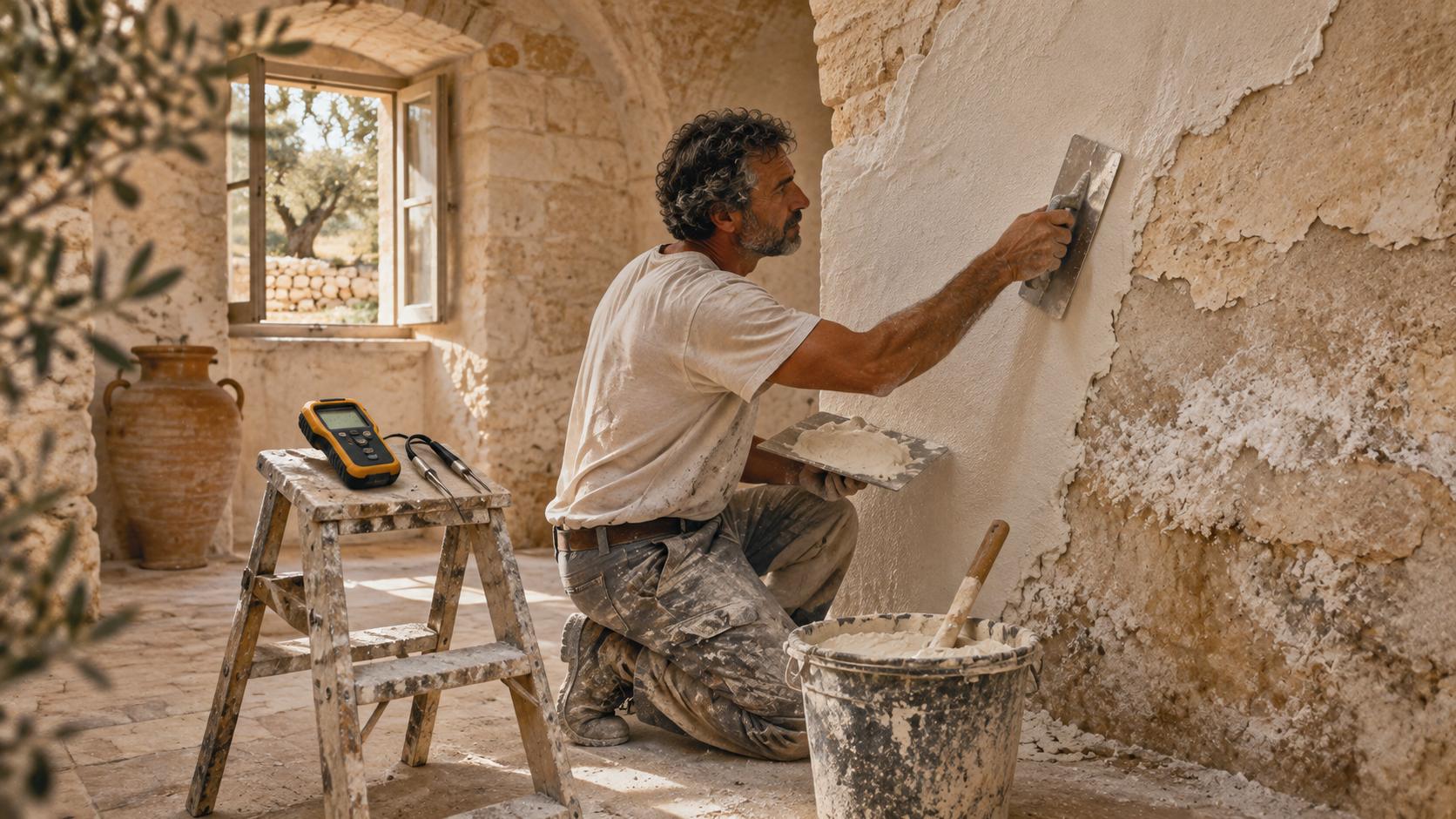
Ostuni faces east onto the Adriatic coast, and the climate leaves its mark in two distinct ways. Along the coast, from Villanova to Rosa Marina, wind-borne salt corrodes metals, renders and window frames: you need stainless steel, treated aluminium, marine-grade paints and more frequent maintenance. In the old houses of the centre and the countryside the classic problem is rising damp: water climbs the walls carrying salts that crystallise inside the stone and plaster, which then flakes and bulges, especially at ground level and in vaulted ground floor rooms. There is almost never a single fix. The answer is a combined approach: a diagnosis based on real instrument readings, dehumidifying lime plasters, correcting the actual causes (roofs, gutters, floors without a ventilated subfloor, rainwater draining into the courtyard), constant ventilation and dehumidification where needed. The most common and most damaging mistake is sealing everything with waterproof paint or cement: the wall stops breathing, the moisture stays trapped, and the mould comes back worse within months. A proper diagnosis before work starts costs little and saves refits.
Permits and constraints: CILA, SCIA and the heritage authorities
Building paperwork in Ostuni follows the national rules, with the extra checks the territory demands. Routine maintenance (painting, floors, sanitary ware, like-for-like windows) falls under edilizia libera and needs no permit. Substantial alterations (taking down internal partitions, rewiring and replumbing in full, internal changes of use) require a CILA, which a surveyor prepares in one or two weeks and files with the municipal one-stop shop. Larger works (volume changes, permitted extensions) need a SCIA, and in some cases a building permit, with timelines of one to six months. The delicate point in Ostuni is the double layer of protection that affects many properties: the historic centre is protected as an urban complex of historic interest, and much of the coastal strip falls under landscape protection, with the same cover extending to trulli, masserie and notable rural buildings. In those cases you need landscape authorisation from the relevant heritage authority on top of the municipal paperwork, and the review can add two or three months to the project. It is not a stopper, but it must be checked before you buy or start: discovering it once the site is open means work stops and fines follow. A surveyor's fee normally runs 800 to 3,000 euros, always shown as a separate line in our quotes.
Services, air conditioning and energy
In this area the system that really changes daily life is cooling: long, hot, humid summers where the perceived temperature runs well above the real one. You need a properly sized heat pump and, above all, humidity control: a split unit that cools but does not dehumidify leaves that clammy feeling everyone knows. Better to specify units with dedicated dehumidification or a ducted system, and to consider mechanical ventilation in well-insulated homes. Electrical systems in old properties should be redone in full, with a new consumer unit, residual current protection and wiring in place for future solar panels; on country houses and masserie, solar plus a heat pump is an investment that usually pays for itself within a few years. On protected buildings, outdoor units and panels must be agreed with the authorities, and on listed facades the discreet route is underfloor systems or carefully hidden units. Plumbing deserves the same care: quality copper or multilayer pipe, accessible manifolds, wall-hung sanitary ware where it helps, and no pipe buried in a wall without a proper record of where it runs.
Real building timelines
The timelines you find online are almost always optimistic. The real numbers are these: a bathroom takes 2 to 4 weeks on site, a kitchen 3 to 6 weeks, a full set of services 3 to 5 weeks. A complete 90 square metre flat runs 3 to 5 months from opening the site, and a house with structures to consolidate, chiancarelle roofs to repair or authorisations to respect runs 5 to 8 months. On top of that come design and paperwork, 30 to 90 days, plus any landscape authorisation, which can add another two or three months. What genuinely stretches a project in this area: long-lead supplies, made-to-measure windows and joinery that must be ordered before work even starts; structural surprises in old walls and vaults, which only appear once the plaster comes off; moving materials through the lanes of the historic centre; and mid-build changes of mind, the most insidious item because it never appears in the original quote. We work to a programme with declared dates, early ordering and verifiable progress: the date we state is the date we keep, with delay penalties written into the contract.
Buying and renovating in Ostuni
Many projects start with a purchase: a flat in the White Town to put on the rental market, a penthouse at the foot of the hill, a masseria or a trullo in the countryside, a coastal holiday home to use with the family and let out the rest of the year. Demand is steady and largely international: Germans, Dutch, French, British and Belgians have been buying here for decades, and a well-renovated property holds its value. Before making an offer, a short list of checks matters more than anything: services, damp and leaks, roof, planning and cadastral compliance, landscape or heritage constraints, aspect and ventilation. A technical survey before you buy costs little and can save you tens of thousands of euros, particularly on trulli, masserie and historic centre houses, where the structures always hide something. For buyers from abroad the only real obstacle is bureaucracy: tax code, remote completion with powers of attorney, international transfers. We often work with clients living outside Italy: video calls, documented photographic surveys, quotes and contracts in your language, and a single point of contact who replies the same day.
How we work: quote, site and guarantees
Our way of working is simple and, for this market, slightly out of the ordinary. First, the quote is an itemised bill of quantities, with quantities, unit prices and materials named by brand and model: a total without a bill of quantities is not a quote, it is a promise. Every line, including paperwork, scaffolding, rubble removal and final cleaning, is spelled out, so the price you read is the price you pay. Second, one contact for the whole project, from the first survey to handover, reachable by phone or WhatsApp. Third, real guarantees: ten-year structural insurance, a two-year warranty on workmanship, delay penalties in the contract and stage payments tied to progress. We work across the municipality of Ostuni and the towns of the Valle d'Itria, from the historic centre to the coast, and we run sites for clients who live abroad. The first step is free: a survey, an analysis of the situation and a detailed quote. Ristrutturazioni Puglia is a step from the White Town and the Adriatic sea: call us on +39 348 191 5367, in Italian, English, German, Dutch and French.
The checklist before you start
Define the real budget
Not just how much you want to spend, but also how much you can set aside for surprises: a practical rule is to reserve 10-15% of the budget for what emerges during the works.
Gather information on the property
Year of construction, last refurbishment, condition of the systems, cadastral floor plan: the more data you give at the site visit, the more realistic the quote will be.
Compare breakdowns, not totals
Two quotes can only be compared item by item: materials, quantities, exclusions. A low total without a detailed breakdown does not mean a saving.
Check warranties and references
Ten-year insurance, penalties for delay, works photographed with dates and places, contacts of previous clients: promises without proof are worth little.
Plan the times of your life
Moves, furniture, any rentals: the programme of works must be cross-checked with your diary to avoid costly overlaps.
Put everything in writing
Specification, programme of works, payment terms, how surprises will be handled: before the start, not during. It is the simplest protection there is.
Take your time with these six points: they cost nothing and protect everything. One piece of advice we repeat to every client: never choose on price alone. A renovation is a project you will live with for years, and the difference between a serious firm and a low-ball offer shows after six months, not on the day you sign. Take the time to visit a site, talk to a previous client, read the contract calmly: those are hours well spent.
One more thing worth saying: the best time to plan a renovation is before you start buying materials or booking trades. A couple of days of thinking at the beginning saves weeks of corrections later. Our job is to help you ask the right questions from day one - and to answer them with numbers, not adjectives. Every guide on this site comes from our real sites: the figures are the ones we meet every day, the mistakes we describe are the ones we have learned to avoid. We update them regularly because prices, incentives and regulations change - and a guide that is a year old can point you in the wrong direction. If something is not clear or you want to explore your specific case, the free site visit is the natural next step.
Frequently asked questions
+How much does it cost to renovate a flat in Ostuni?
A full renovation runs between 190 and 430 euros per square metre: for a 90 square metre flat that means 17,000 to 39,000 euros of building work. In the historic centre add rubble removal often by hand, narrow scaffolding and a margin for surprises in old walls, plus design and paperwork between 800 and 3,000 euros.
+Do I need heritage authority approval in the historic centre?
It depends on the property: the historic centre is protected as an urban complex of historic interest, and many buildings also fall under landscape protection, as does much of the coastal strip. In those cases landscape authorisation is required on top of the municipal paperwork: timelines stretch by two or three months, but work does not stop if the check is done before you start.
+How do you lay chianche floors so they last?
With expert laying: sorting and matching the slabs, a properly cured screed, calibrated joints, correct sealing and finishing. Badly laid chianche move and crack, and redoing them means breaking everything out. Choose a firm that has actually laid them before, not just photographed them.
+How do you get rid of damp in old local houses?
With a combined approach: instrument-based diagnosis, dehumidifying lime plasters, fixing the real causes (roofs, gutters, floors without a ventilated subfloor, rainwater drainage), steady ventilation and dehumidification where needed. Sealing everything with waterproof paint or cement is the most common mistake and brings the mould back worse than before.
+How long does a renovation site last in Ostuni?
A complete 90 square metre flat takes 3 to 5 months on site, a bathroom 2 to 4 weeks, a house with structures, stone roofs or authorisations 5 to 8 months. Add design and paperwork, 30 to 90 days, plus any landscape authorisation. Long-lead supplies must be ordered before the site opens.
+Is it worth renovating a trullo or masseria for letting?
Yes, if the budget is realistic and the structure is sound: demand and rates are steady year-round. But chiancarelle roofs and trullo cones need specialist hands, and these buildings are often protected. A technical survey before buying almost always pays for itself.
+Which tax incentives apply to renovation in 2026?
The core IRPEF deduction for substantial maintenance remains, with a spending cap spread over ten years, alongside deductions for energy upgrades (insulation, windows, heat pumps) and facade work where applicable. You need a compliant bank transfer, itemised invoices, system certificates and ENEA filing where required: we hand over the complete package at the end of the works.
+Can I manage the renovation from abroad?
Yes: we regularly work for clients living in Germany, the Netherlands, France and Belgium. Scheduled video calls, photo documentation of every stage, quotes and contracts in your language, stage payments by bank transfer and one contact throughout. At handover you receive the full document pack, including compliance certificates and warranties.
Want to apply this guide to your own case?
Free site survey across Puglia: we assess your situation and give you real numbers, not blind estimates.
Request your free quoteCosts and timelines
Costs are built to measure after the free survey: every item is quantified and timelines are written into the contractual schedule. For Renovating a house in Ostuni: costs, permits and materials we always give a realistic range before starting.
How we work
One method: survey, itemised bill of quantities, contract with penalties, documented site with photos and inspected handover. The same person follows Renovating a house in Ostuni: costs, permits and materials from start to finish.
Guarantees
Two-year warranty on defects, ten-year where required, certified system compliance and late-delivery penalties written into the contract. No extra cost without your written approval.
How to get started
Request the free quote: we reply within 24 working hours, book the survey in your town and you receive a detailed proposal within a week.
Frequently asked questions
Answers to the most common questions about costs, timelines and permits for Renovating a house in Ostuni: costs, permits and materials. If your question is missing, write to us: we always reply.