Building works contract: what it must contain to protect you
An accepted quote is not enough: without a written contract detailing the works, price, timeline and warranties, every dispute comes down to one word against another. Here is what must be in it.

What the works contract actually regulates
A works (appalto) contract is the one under which a company undertakes to complete a building project for a fee, organising its own means and bearing the execution risk (art. 1655 of the Italian Civil Code). No special form is required: a quote sent by email and accepted in writing can be binding. The risk lies entirely in the missing details. Keep it distinct from a single work contract with a professional, and watch out for subcontracting: if you do not want it, you must ban it in writing, otherwise the company may bring in third parties without asking you.
The elements that cannot be missing
Three attachments make the difference: the technical specification (what is to be done and with which materials), the bill of quantities (each item priced), and the design drawings. The contract must then state the price and how it is determined (lump sum, measured or mixed), the start date and completion deadline, the amounts and dates of payments, penalties for delay and the rules for variations. Also write down who supplies the materials, who disposes of the rubble and who handles the permits: these are the items that most often trigger disputes at the end of the site.
Price, payments and withholdings
Never a single payment at the end: structure instalments around verifiable progress certificates, usually two or three, and keep a final balance until the works are checked. As a private individual you pay by traceable bank transfer and, for tax-deductible expenses, with the specific tax bonus transfer on which the bank applies an 8% withholding. The 4% withholding on contract payments applies instead to withholding agents such as condominiums. Flat-rate regimes on the invoice do not remove the electronic invoicing obligation nor the need for traceable payment.
Timelines, penalties and variations
The completion date must be an actual date, not a vague formula such as 'about three months'. Attach a reasonable daily penalty to the delay: that is exactly what makes the schedule enforceable. Variations, meaning any change to works, materials or timing agreed during the works, must always be put in writing with their impact on price and timing before being carried out. Also set out the procedure for suspending the works and the cases of force majeure: without these rules every unexpected event becomes a negotiation.
The warranties the contract must refer to
Even without special clauses the law protects the client: for defects and non-conformities the contractor answers under the two-year warranty of articles 1667 and 1668 of the Civil Code, to be reported within 60 days of discovery, with the claim time-barred two years after delivery. For buildings article 1669 applies instead: ten years of liability for collapse or serious defects, to be reported within one year of discovery. Ask for a liability insurance policy and the ten-year latent defects cover where applicable, and check the company is registered with the Chamber of Commerce and regularly pays its contributions.
Safety, documents and tax deductions
For building sites the client must check the company's DURC contribution compliance certificate before awarding the contract and appoint the works safety coordinator when more than one company is involved, as required by Legislative Decree 81/2008. These obligations belong in the contract together with the site rules. On tax deductions, the 2026 Budget Law confirms 50% for a main residence, with a maximum deduction of 48,000 euro on 96,000 euro of spending in ten annual instalments, and 36% in other cases. Keeping them requires electronic invoicing and the tax bonus transfer, and the contract must separate eligible items from non-deductible ones.
The checklist before you start
Define the real budget
Not just how much you want to spend, but also how much you can set aside for surprises: a practical rule is to reserve 10-15% of the budget for what emerges during the works.
Gather information on the property
Year of construction, last refurbishment, condition of the systems, cadastral floor plan: the more data you give at the site visit, the more realistic the quote will be.
Compare breakdowns, not totals
Two quotes can only be compared item by item: materials, quantities, exclusions. A low total without a detailed breakdown does not mean a saving.
Check warranties and references
Ten-year insurance, penalties for delay, works photographed with dates and places, contacts of previous clients: promises without proof are worth little.
Plan the times of your life
Moves, furniture, any rentals: the programme of works must be cross-checked with your diary to avoid costly overlaps.
Put everything in writing
Specification, programme of works, payment terms, how surprises will be handled: before the start, not during. It is the simplest protection there is.
Take your time with these six points: they cost nothing and protect everything. One piece of advice we repeat to every client: never choose on price alone. A renovation is a project you will live with for years, and the difference between a serious firm and a low-ball offer shows after six months, not on the day you sign. Take the time to visit a site, talk to a previous client, read the contract calmly: those are hours well spent.
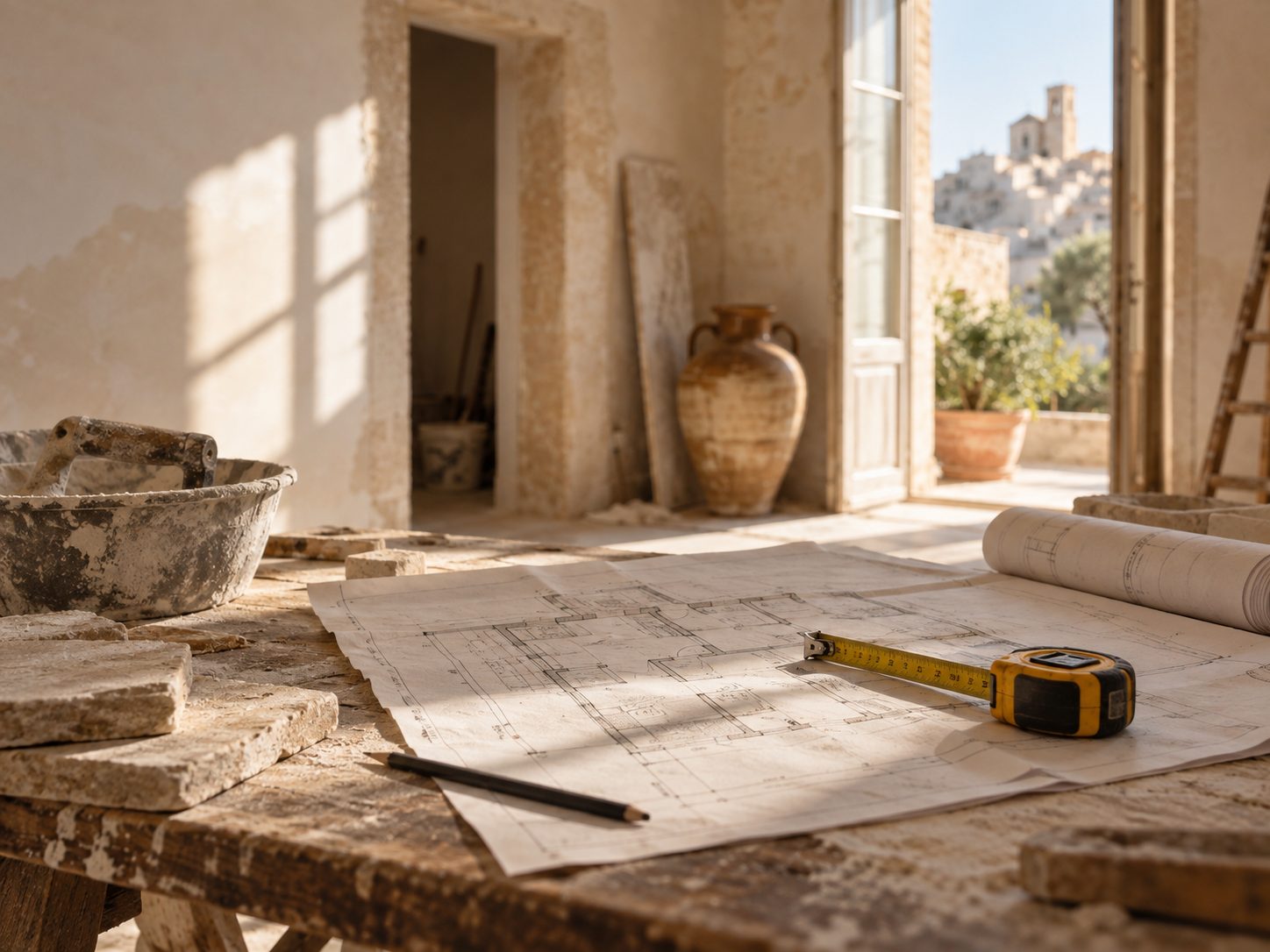
One more thing worth saying: the best time to plan a renovation is before you start buying materials or booking trades. A couple of days of thinking at the beginning saves weeks of corrections later. Our job is to help you ask the right questions from day one - and to answer them with numbers, not adjectives. Every guide on this site comes from our real sites: the figures are the ones we meet every day, the mistakes we describe are the ones we have learned to avoid. We update them regularly because prices, incentives and regulations change - and a guide that is a year old can point you in the wrong direction. If something is not clear or you want to explore your specific case, the free site visit is the natural next step.

Frequently asked questions
+Does the works contract have to be in writing?
It is not mandatory, but it is the only real protection: without written records, proving agreements on price, materials and timing falls entirely on the party making the claim. A signed contract with the bill of quantities attached is worth more than ten emails.
+How much of an advance is normal to pay the company?
An initial advance between 10% and 30% is standard practice; the rest follows the progress certificates. Be wary of anyone asking for most of the money before entering the site, and keep a final balance to be released at the end of the warranty period.
+What happens if the company finishes late?
If the contract provides for a penalty you can apply it; otherwise you must prove the damage. In case of serious delay you can set a reasonable additional deadline and, if it is not met, ask for termination of the contract.
+Can I withdraw whenever I want?
Yes: the client may withdraw at any time under article 1671 of the Civil Code, but owes the company the price of the work done, the expenses incurred and the lost profit. It is better to quantify these amounts in the contract from the start.
+Is the DURC certificate really necessary?
Yes: for building sites it must be checked before the contract is awarded. Without a valid DURC the company cannot work on site, and responsibility also falls on the client.
Want to apply this guide to your own case?
Free site survey across Puglia: we assess your situation and give you real numbers, not blind estimates.
Request your free quoteCosts and timelines
Costs are built to measure after the free survey: every item is quantified and timelines are written into the contractual schedule. For Building works contract: what it must contain to protect you we always give a realistic range before starting.
How we work
One method: survey, itemised bill of quantities, contract with penalties, documented site with photos and inspected handover. The same person follows Building works contract: what it must contain to protect you from start to finish.
Guarantees
Two-year warranty on defects, ten-year where required, certified system compliance and late-delivery penalties written into the contract. No extra cost without your written approval.
How to get started
Request the free quote: we reply within 24 working hours, book the survey in your town and you receive a detailed proposal within a week.
Frequently asked questions
Answers to the most common questions about costs, timelines and permits for Building works contract: what it must contain to protect you. If your question is missing, write to us: we always reply.