Renovating a house in Lecce: the Salento guide
Renovating in Lecce means dealing with pietra leccese, historic centre rules and a climate that bakes in summer and dampens in winter. This guide sets out real costs per square metre, the permits you actually need, the local materials that work and realistic timelines for the site, so you can budget with confidence.
Lecce and the Salento: where renovation actually happens
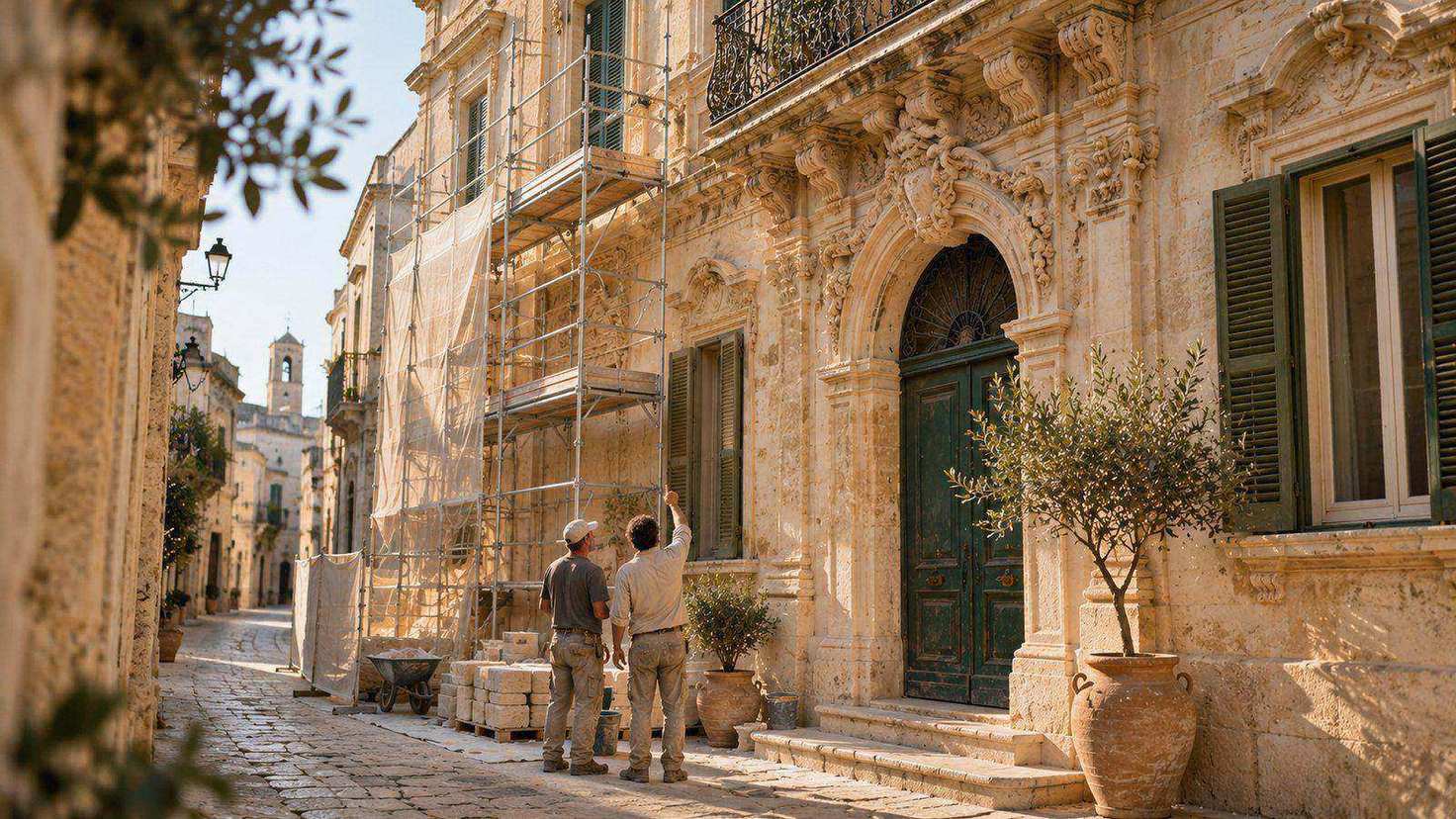
The Salento renovation market runs on three distinct tracks. The first is the historic centre of Lecce, with its baroque palaces in pietra leccese around Santa Croce, the cathedral and the lanes of Rudiae: old apartments, star-shaped vaults, thick walls and almost always some heritage constraint to verify. The second track is the surrounding towns, Cavallino, Surbo, San Cesario di Lecce, Vernole, Trepuzzi, Squinzano, Novoli, Lizzanello and Melendugno, where detached and terraced houses built in the 1960s, 1980s and 2000s now need bringing up to date. The third track is the coast and the tourist hinterland, from Torre dell'Orso and San Foca to Porto Cesareo, Nardo, Gallipoli, Otranto and Santa Maria di Leuca. Here people renovate second homes, villas with pools, former farmhouses and small guesthouses, often for German, Dutch, French and Belgian owners. Each track carries different costs, paperwork and risks, and treating them all the same will distort both your timeline and your budget.
What a renovation really costs in Lecce
Our local figures match the regional ones: a complete renovation sits between 190 and 430 euros per square metre of floor, and that range depends almost entirely on the starting condition and the finishes you choose. A 90 sqm apartment in central Lecce therefore means between 17,000 and 39,000 euros of building works, on top of which come the design, the permits, furniture and appliances. The split is always similar: services account for 25 to 30 per cent of the total, finishes for 35 to 45, demolition and structures for 10 to 20, the rest in paint, windows and contingencies. A bathroom of 4 to 6 sqm takes 3,000 to 7,000 euros, while a kitchen runs 300 to 600 euros per square metre of floor for the building part alone. In the historic centre, also allow for narrow scaffolding, rubble carried out by hand when the mini loader will not fit, and the surprises hidden in old walls. Keep a margin of 10 to 15 per cent on the budget: plan on using it rather than hoping you will not.
Pietra leccese, carparo, chianche and coppi: the local materials
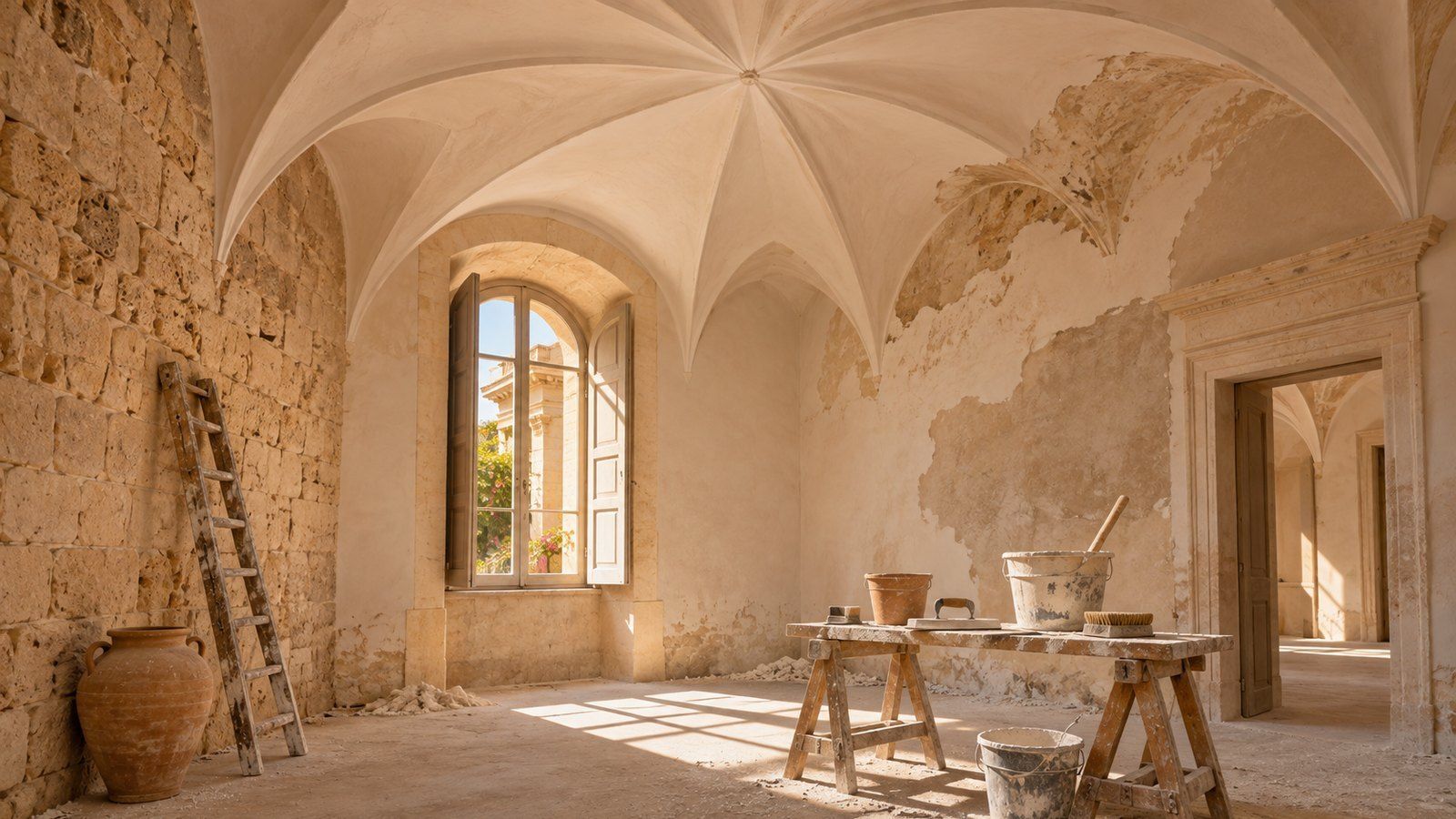
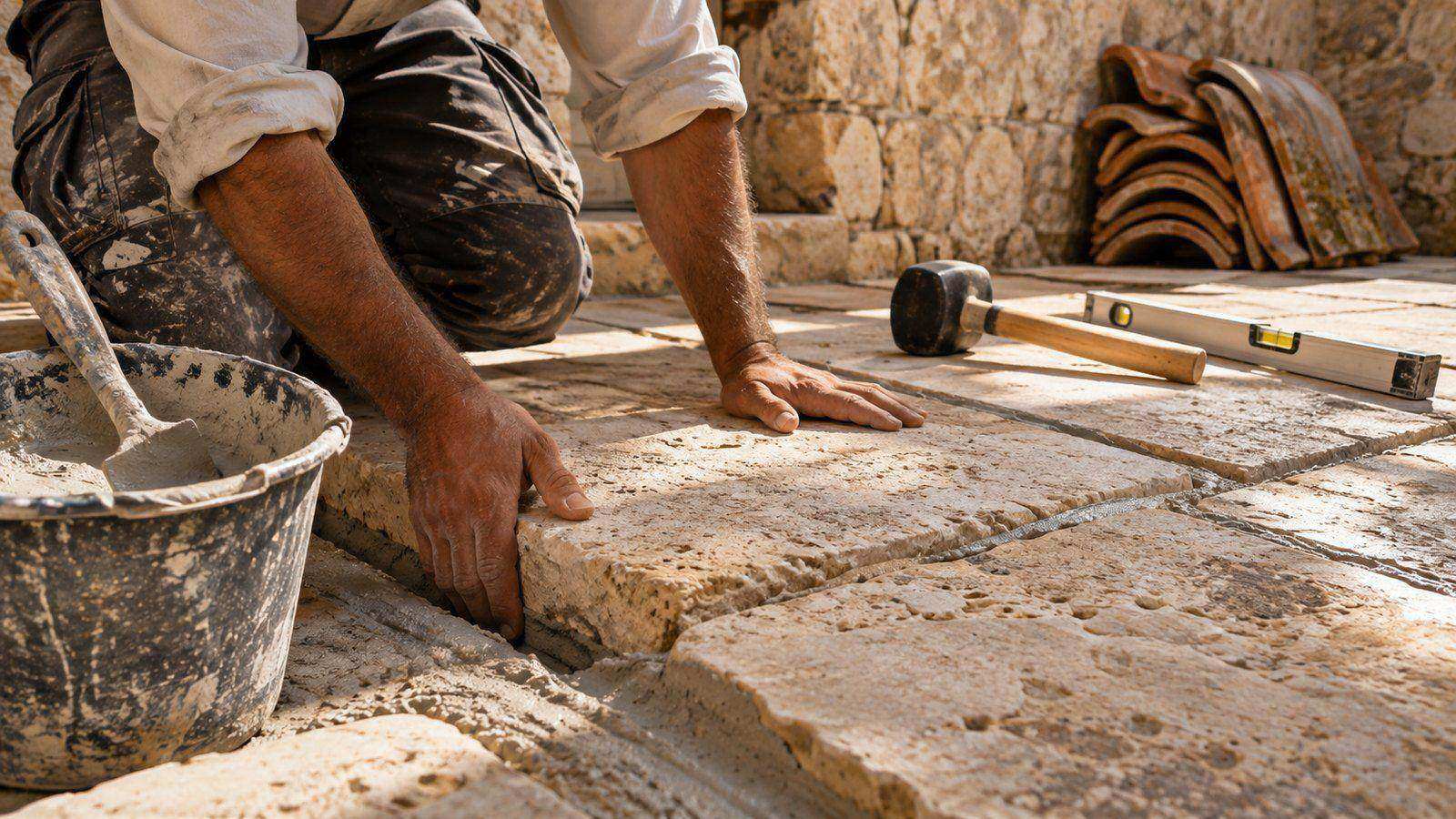
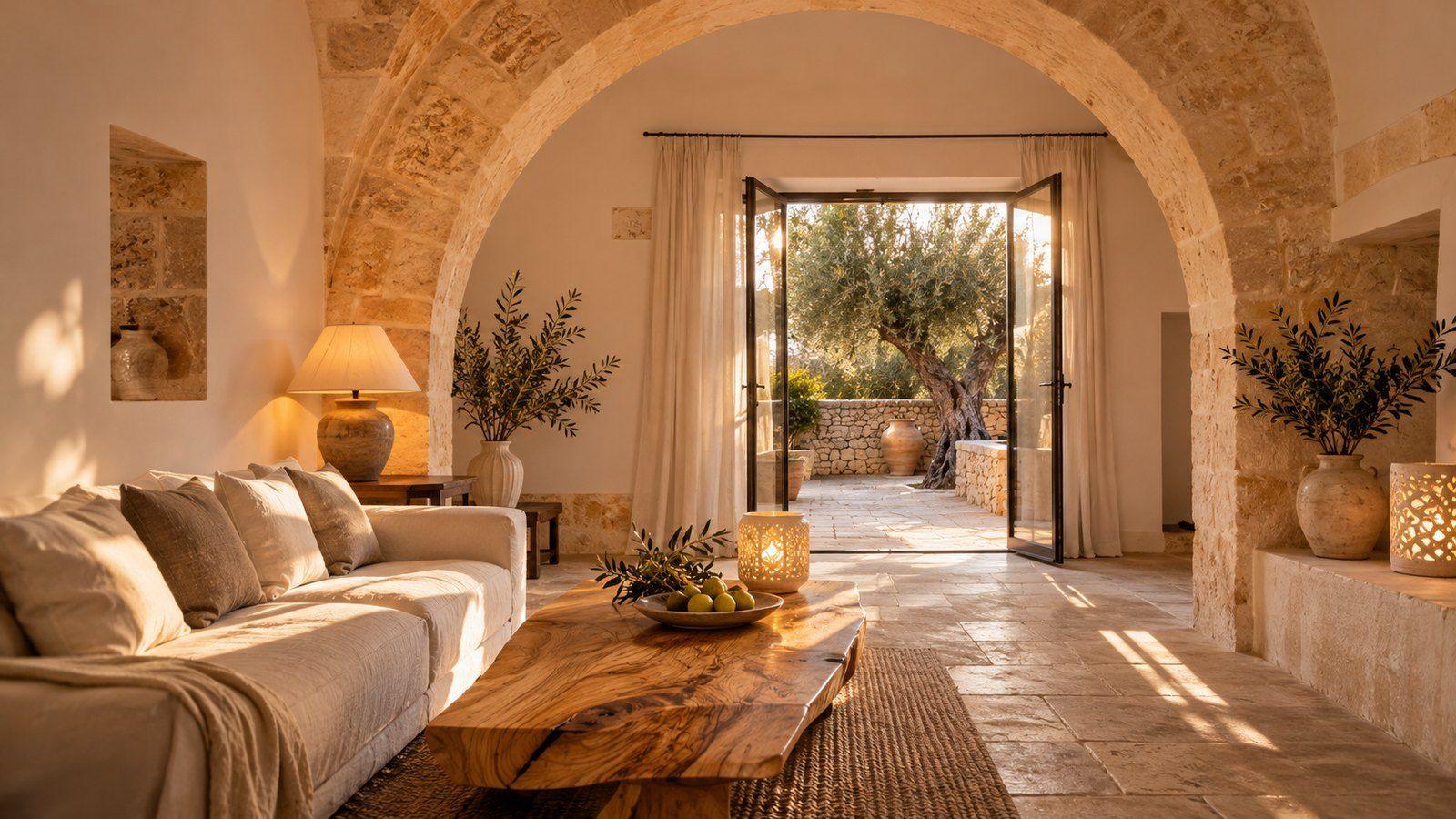
Pietra leccese is a soft limestone, ivory or golden in colour, worked with a chisel, and it gives Lecce and the whole of Salento their identity. It is beautiful, porous and deserves respect: aggressive impregnating sealers darken it unevenly, cement-based fillers make it decay from within. Historic walls are often pietra leccese or carparo, the yellow-grey calcareous tuff typical of the land between Nardo, Galatina and Galatone, held together by lime mortars that must be reproduced in restoration renders. Cement mortar laid over ancient masonry is the main cause of detachment and mould. Traditional floors are in chianche, local limestone slabs that, well laid and protected, last for generations. Roofs carry coppi and canal tiles, and many houses keep star vaults or Lecce vaults that must be consolidated before any finishing. For new builds and 1980s villas the argument changes: reinforced concrete, brick, and there you reason with modern insulating materials, without nostalgia for methods that no longer perform.
Damp in the Salento climate
Salento has hot, dry summers, yet the winters are mild and humid, the scirocco wind brings air saturated with sea moisture even ten kilometres inland, and old houses almost always suffer from rising damp: water climbs the walls carrying salts that burst open inside the stone and plaster, which blisters and swells. The solution is rarely a single measure, so a combined approach is needed: lime-based dehumidifying renders with porous aggregates, steady ventilation of the rooms, dehumidifiers where required, and above all the correction of the causes, roof leaks, broken gutters, floors with no ventilated void beneath them. On the sea front, from San Cataldo to Torre dell'Orso and on to Gallipoli, salt corrodes metals and renders, so specify stainless steel, treated aluminium and breathable paints formulated for marine settings. The most common mistake is sealing everything with waterproof paint or cement: breathability stops, the moisture stays trapped, and the mould returns worse than before. A proper diagnosis, with moisture readings taken with instruments, costs little and saves a full redo.
Permits and constraints: CILA, SCIA and the Soprintendenza
Building paperwork in Salento follows national rules, but local constraints are added on top. Ordinary maintenance, meaning painting, floors, sanitary units and windows of identical size, falls under free building activity. Extraordinary maintenance, knocking down internal partitions, replacing services in full or changing internal use, requires a CILA, a filing that a technician prepares in one or two weeks and lodges with the municipal building office. Larger works, extensions within permitted limits or changes in volume require a SCIA and in some cases a full building permit, with procedures running from one to six months. The sensitive point in Lecce is the constraint itself: many properties in the historic centre and along the coast are protected under landscape and cultural rules, and in that case you need authorisation from the Soprintendenza for your area, whose review can add two or three months to the site. That is not a block, but it must be checked before you buy or start: discovering it mid-project costs idle site days and fines. The technician fee normally falls between 800 and 3,000 euros, always itemised separately in the quote.
Services, climate control and energy use
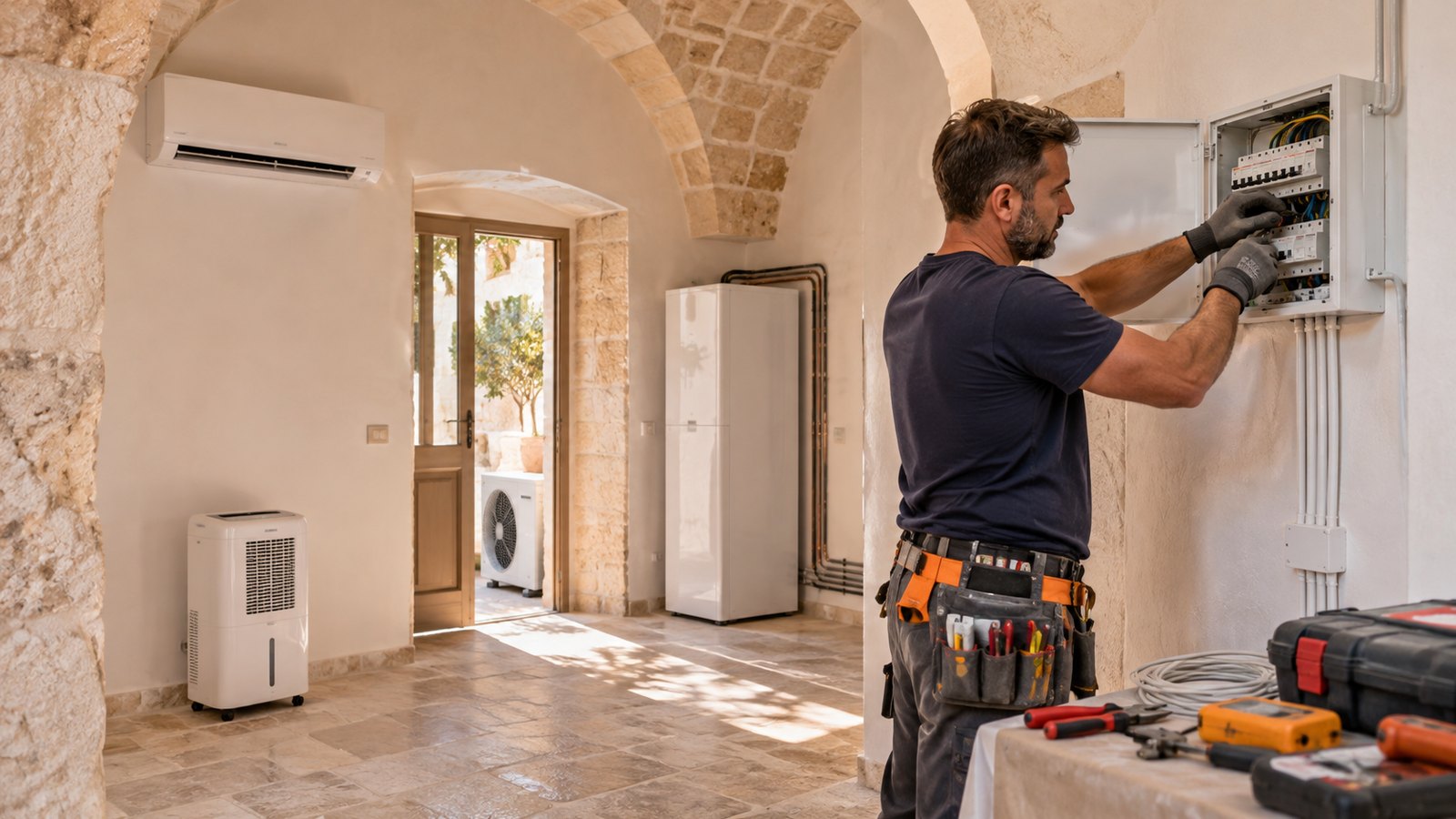
In Salento houses the system that genuinely changes daily life is climate control. Long hot summers require a heat pump sized properly, and above all humidity management: a split unit that cools but does not dry the air leaves that heavy stillness indoors that everyone in Puglia knows. Better to plan air conditioners with a dedicated dehumidification mode, or a ducted system, and to weigh mechanical ventilation in well insulated homes. The electrics should be renewed in full in older properties, with a new consumer unit, residual current protection and wiring ready for solar panels: on villas and farmhouses, photovoltaic paired with a heat pump is very often an investment that pays back within a few years, and current tax deductions shorten that further. In listed buildings, outdoor units and panels must be agreed with the heritage authorities, and on protected facades you choose discreet solutions or underfloor systems. The water supply deserves equal care: quality copper or multilayer pipe, accessible manifolds, wall-hung sanitaryware where useful, and no buried pipe without an as-built record.
Realistic site timelines
The schedules you see quoted online are almost always optimistic. Our real numbers are these: a bathroom to redo needs 2 to 4 weeks on site, a kitchen 3 to 6 weeks, a complete replacement of services 3 to 5 weeks. A whole 90 sqm apartment runs between 3 and 5 months from the opening of the site, and a house with structures to consolidate, a roof to rebuild or constraints to respect runs between 5 and 8 months. Add to those the design and the permits, 30 to 90 days, plus any authorisation from the Soprintendenza, which can add a further two or three months. What really stretches projects: long lead deliveries, made to measure windows and bespoke joinery, all of which should be ordered before work begins; structural surprises in old masonry; and changes of mind during the job, the most insidious item because it never appears in the original quote. We work from a written programme with stated dates, early ordering and verifiable progress: a date we state is a date we keep, or the contract carries a penalty.
Buying and renovating in Salento
Many projects begin with a purchase: an apartment in central Lecce, a villa with a garden between Cavallino and Surbo, a masseria or farmhouse towards Nardo, Galatina or Otranto, a seaside home to adapt for family use or a small guesthouse. Before you make an offer, check a handful of things that matter: the state of the services, damp and leaks, the roof, planning and cadastral compliance, landscape or historic constraints, orientation and airflow. A technical survey before buying costs little and can save tens of thousands of euros, especially on older properties where the structure always hides something. For buyers from abroad the difficulty lies only in the paperwork: tax code, completion carried out remotely with powers of attorney, international bank transfers, and the need to understand costs and timings in a language other than Italian. We often work with German, Dutch and French clients through video calls, documented photographic surveys, quotes and contracts in their own language, and a single contact who answers the same day. Anyone buying to let in a tourist area should also measure real seasonality, not the promises of the booking portals.
How we work: quote, site and guarantees
Our way of working is simple and slightly off standard for this market. First, the quote is a bill of quantities with line items, giving quantities, unit rates and materials identified by brand and model: a total without a breakdown is not a quote, it is a promise. Every line, permits, scaffolding, rubble removal, final clean, is stated openly, so the price you read is the price you pay. Second, one point of contact for the entire site, from the first survey to the handover of keys, reachable by phone or on WhatsApp. Third, real guarantees: ten year structural insurance, a two year warranty on workmanship, penalty clauses for delay in the contract, and payment stages tied to verified progress. We work across the province of Lecce and the whole of Salento, from the historic centre to the coast, and we also run sites for clients living outside Italy. The first step is free: a survey, an assessment of your situation and a detailed quote. Ristrutturazioni Puglia is a step from the sea and the baroque: we answer on +39 348 191 5367, in Italian, English, German, Dutch and French.
The checklist before you start
Define the real budget
Not just how much you want to spend, but also how much you can set aside for surprises: a practical rule is to reserve 10-15% of the budget for what emerges during the works.
Gather information on the property
Year of construction, last refurbishment, condition of the systems, cadastral floor plan: the more data you give at the site visit, the more realistic the quote will be.
Compare breakdowns, not totals
Two quotes can only be compared item by item: materials, quantities, exclusions. A low total without a detailed breakdown does not mean a saving.
Check warranties and references
Ten-year insurance, penalties for delay, works photographed with dates and places, contacts of previous clients: promises without proof are worth little.
Plan the times of your life
Moves, furniture, any rentals: the programme of works must be cross-checked with your diary to avoid costly overlaps.
Put everything in writing
Specification, programme of works, payment terms, how surprises will be handled: before the start, not during. It is the simplest protection there is.
Take your time with these six points: they cost nothing and protect everything. One piece of advice we repeat to every client: never choose on price alone. A renovation is a project you will live with for years, and the difference between a serious firm and a low-ball offer shows after six months, not on the day you sign. Take the time to visit a site, talk to a previous client, read the contract calmly: those are hours well spent.
One more thing worth saying: the best time to plan a renovation is before you start buying materials or booking trades. A couple of days of thinking at the beginning saves weeks of corrections later. Our job is to help you ask the right questions from day one - and to answer them with numbers, not adjectives. Every guide on this site comes from our real sites: the figures are the ones we meet every day, the mistakes we describe are the ones we have learned to avoid. We update them regularly because prices, incentives and regulations change - and a guide that is a year old can point you in the wrong direction. If something is not clear or you want to explore your specific case, the free site visit is the natural next step.
Frequently asked questions
+How much does a full renovation cost in the historic centre of Lecce?
A complete renovation runs between 190 and 430 euros per square metre, so a 90 sqm apartment means roughly 17,000 to 39,000 euros of building works. In the historic centre you must add narrow scaffolding, rubble removal that is often done by hand and a contingency for surprises in old walls, plus design and permits at 800 to 3,000 euros. Furniture and appliances are quoted separately, and we itemise every line in writing.
+Should pietra leccese be preserved or replaced?
In almost every case it should be preserved and treated, not replaced. Pietra leccese is porous and reacts badly to aggressive sealers and cement: it is cleaned with gentle methods, consolidated where it has decayed, and protected with breathable impregnators. Only stone that is beyond rescue is exchanged, using new blocks from the same quarry and matching workmanship. Replacing sound historic stone without reason wastes money and removes the character that buyers pay for in Lecce.
+Do I need Soprintendenza approval in the historic centre?
It depends on the property. Many buildings in the historic centre and along the coast fall under landscape or cultural protection, and in that case you need authorisation from the Soprintendenza for your area, alongside the filings at the town hall. Timings stretch by two or three months, but the work itself does not stop. The essential point is to verify the status before you start, not once the site is open, when delays turn into penalties.
+How long does a renovation take in Lecce?
A complete 90 sqm apartment needs 3 to 5 months on site, a bathroom 2 to 4 weeks, a kitchen 3 to 6 weeks, and a house with structural work or heritage constraints 5 to 8 months. Design and permits add 30 to 90 days, and any Soprintendenza authorisation can add two or three months more. Long lead items such as windows and bespoke joinery should be ordered before the site opens.
+How do you remove damp from an old Salento house?
With a combined approach: measurements taken with proper instruments, lime based dehumidifying renders, repair of the causes such as roofs, gutters and floors, steady ventilation and controlled dehumidification. Sealing everything with waterproof paint or cement is the most common error and brings the mould back worse than before. Coastal properties also need materials that resist sea salt, including stainless fixings and marine grade paints. One measure alone rarely holds, so diagnosis comes first.
+Can I manage the renovation from outside Italy?
Yes, we regularly work for clients living in Germany, the Netherlands, France and Belgium. You receive scheduled video calls, documented photographs of every phase, quotes and contracts in your language, traceable payments tied to verified progress, and one named contact throughout. Before completion we check the tax code, the remote deed with powers of attorney and international transfers. At handover you get the full document pack, including compliance certificates and warranties.
+Which tax deductions apply to renovation in 2026?
The main stay is the personal income tax deduction for extraordinary maintenance, spread over ten years within a set spending limit, joined by deductions for energy efficiency such as insulation, windows and heat pumps, plus facade works where applicable. You need a bonifico parlante, which is the Italian bank transfer typed with the correct beneficiary data and tax code, itemised invoices, wiring documentation and an ENEA filing where required. We deliver the complete pack at the end of the works.
Want to apply this guide to your own case?
Free site survey across Puglia: we assess your situation and give you real numbers, not blind estimates.
Request your free quoteCosts and timelines
Costs are built to measure after the free survey: every item is quantified and timelines are written into the contractual schedule. For Renovating a house in Lecce: the Salento guide we always give a realistic range before starting.
How we work
One method: survey, itemised bill of quantities, contract with penalties, documented site with photos and inspected handover. The same person follows Renovating a house in Lecce: the Salento guide from start to finish.
Guarantees
Two-year warranty on defects, ten-year where required, certified system compliance and late-delivery penalties written into the contract. No extra cost without your written approval.
How to get started
Request the free quote: we reply within 24 working hours, book the survey in your town and you receive a detailed proposal within a week.
Frequently asked questions
Answers to the most common questions about costs, timelines and permits for Renovating a house in Lecce: the Salento guide. If your question is missing, write to us: we always reply.